I, Hurt
Pain insists upon being attended to - CS Lewis
Pain changes the weather in a room. You can feel it before you quite know what it is. The pressure drops. Something gathers. The air thickens around a person who is hurting, whether they choose to tell you or not, and the rest of us make a thousand tiny calculations about what to do with it. We look towards it, then away. We offer tea. We make a joke. We become terribly practical. We ask whether there is anything we can do, which is sometimes another way of asking whether there is anything we can do to make the discomfort of witnessing it go away. Pain is strangely private and embarrassingly public at the same time. It belongs entirely to the person experiencing it, yet once we have seen it, really seen it, a small portion of it belongs to us too. We carry a splinter of it away. Years later, often decades later, it is still there beneath the skin.
I have been thinking about pain because I have come to believe that some of the most meaningful work I have ever been part of began at exactly this moment, when somebody else’s hurt stopped being information and became something I could feel. Not understand completely, because I am increasingly suspicious of that particular promise of empathy. We say, I know how you feel, when of course we rarely do. Your grief is not my grief. Your body is not my body. Your history, your nerves, your fear, your private three o’clock in the morning negotiations with yourself are entirely your own. Perhaps empathy is not the ability to crawl inside another person and inhabit their pain. Perhaps it is something more modest and more demanding. The willingness to stand close enough to it that we are changed by what we see.
Many years ago I met a boy called Michael.
I remember his fingers.
We were working on a project concerning phenylketonuria, PKU, a rare metabolic condition that prevents the body from properly processing an amino acid found in protein. For the young people we met, food was therefore less a source of pleasure than a daily negotiation with danger. Meat, cheese, nuts, ordinary bread, the casual architecture of teenage eating all became complicated. They lived in a world where the cheese sandwich, the hamburger, the slice of pizza snatched from somebody else’s plate contained rules invisible to everyone around them. Their treatment involved taking a nutritional formula which, in those days, was difficult to tolerate. It smelled terrible. It tasted worse. I had tried it myself in a client conference room, full of the confidence of somebody about to demonstrate solidarity, and promptly vomited it back onto the table. The body is occasionally an excellent critic.
One of the teenagers we met was Sean, seventeen, from Handsworth in Birmingham. At school, other boys had mocked the strange sandwiches his mother packed for him. One day they held him down and forced a kebab into his mouth because they wanted to see what would happen. They imagined some dramatic reaction, his head exploding perhaps, the grotesque theatre of adolescent cruelty. Nothing did happen, at least nothing they could see. The damage of PKU is cumulative. The more immediate injury was humiliation. From then on Sean began eating with them, throwing away the food his mother carefully prepared, choosing the danger of belonging over the safety of being different. His health deteriorated almost invisibly alongside it.
I have thought about that choice for more than twenty years. We tend to imagine health behaviour as rational, a clean little transaction between knowledge and action. Tell someone what is good for them and surely, eventually, they will do it. But bodies live inside lives. Medicine lives inside school cafeterias and first dates and changing rooms and families and shame. A treatment can be scientifically perfect and humanly impossible. Sean did not lack information. He knew exactly what he was supposed to eat. What he could not bear was what the treatment announced about him every time he took it out of his bag. I am different. I am ill. Look at me.
Then there was Michael.
Michael could not tolerate the powdered formula, so instead he took pills. Forty at a time, three times a day. One hundred and twenty tablets every day, more than eight hundred a week. The pills came sealed in blister packs, and several times a week Michael and his mother sat together at their kitchen table pressing them out, one after another, hundreds of tiny clicks and pops, collecting them into a bowl before dividing them into bags he could carry with him. I imagine that table still. The bowl between them. The television perhaps murmuring from another room. The mechanical repetition of thumb, finger, foil, pill. Thumb, finger, foil, pill. The small domestic factory of staying alive.
Michael showed me his hands. The tips of his thumbs and forefingers were raw and blistered from pushing so many tablets through so much foil. This was not the pain we had gone looking for. It was not on any project brief. There was no box on a research plan marked bleeding fingertips. Nobody had described it in the clinical literature we had absorbed before meeting him. Yet there it was, in front of us, perhaps the most important piece of data we would encounter, except that calling it data now feels almost obscene. They were a child’s fingers.
And he wanted to learn to play the guitar.
Something changed for me in that moment.
Design had until then been about solving a problem. Suddenly the problem had a body. Better still, it had fingertips. The abstraction collapsed. We were no longer designing a better way to deliver nutrition to young people with a metabolic condition. We were trying to stop Michael’s fingers from hurting. We were trying to give him enough normality that he might sit in a bedroom somewhere pressing those same fingers onto guitar strings instead of pharmaceutical blister packs. We were trying to help Sean walk into a school cafeteria carrying something that did not announce his difference before he had even opened his mouth.
That shift sounds slight. It is enormous.
When we later asked the young people what the products should look like, they did not ask for medical sophistication. They wanted things that looked normal. Cool, even. Something Nike might make. On the table were all the things adults thought might inspire them, health products, supplements, unusual packages, specialist foods, alongside ordinary supermarket detritus, crisps, fizzy drinks, fast food. They went to the ordinary things. Of course they did. The insight was almost painfully obvious once we allowed ourselves to see the world from where they were standing.
I wrote in my notebook that night: Not “designed.” Normal.
Eventually the work became a small squeezable pack of highly concentrated formula, brightly coloured, portable, something closer to a sports drink than a medical intervention. A nozzle allowed the formula to be taken quickly, avoiding some of the smell and gag reflex. It won awards. It performed commercially. All the things businesses quite reasonably like to count happened afterwards. But none of them explain why the work became good. The work became good much earlier, around a kitchen table, when a boy held out his hands.
This is the part of empathy we do not talk about enough. We have professionalised it. We put it into processes and frameworks, print it on walls, turn it into a phase of a methodology. We make maps of it, which seems both useful and faintly absurd. Empathy is now something teams are instructed to do before moving on to ideation. But the empathy that has mattered most to me has never behaved like a workshop exercise. It has been inconvenient. It lingers. It destabilises the problem you thought you had come to solve. It removes the safe distance between you and the person on the other side of the brief.
I remember another occasion when this happened in a very different room.
A colleague and I had been invited to pitch for a piece of work, something we were rarely asked to do at IDEO. We arrived to discover that several agencies were presenting in front of one another, and that we were the last of three. Before us came formidable presentations full of research methodologies and thousands of data points, market share, statistical confidence, proprietary processes, the reassuring apparatus of knowing what one is doing. One company talked proudly about synthesising vast quantities of information into a compelling proposition. There were enormous collages of advertising and all the muscular confidence of people who had clearly done this many times before. Sitting there watching them, I thought we were going to lose.
When our turn came, we played a film.
It showed an older woman living with an agonising skin condition. For reasons of confidentiality the camera revealed almost nothing of her. You saw her hands. You saw her badly blistered knee. You heard her describe the physical pain, but also another kind of pain underneath it, her embarrassment at becoming a burden to her family and her doctor. At one point she cried. There was no music telling us what to feel, no elegant synthesis, no chart arriving afterwards to translate the experience into percentages. There was simply a human being hurting in front of us.
After about a minute I stopped the film.
The room changed.
The most senior client sat for a moment, visibly shaken, and then said that watching her had reminded him why he came to work every day. He never wanted to see somebody experiencing that kind of pain when his organisation might be able to help.
We won the work, yes, but again that feels like the least interesting part of the story. What happened in that minute was that everybody in the room remembered what the work was for.
This is what pain can do when we allow ourselves to witness it. It strips away the professional insulation we build around problems. Numbers tell us how many people are suffering. Pain introduces us to one of them. Both matter. Scale matters. Evidence matters. Rigour matters. But a percentage cannot wince. A market segment cannot be embarrassed. A dataset does not have a mother sitting beside it at a kitchen table pressing pills through foil.
Perhaps this is why one person’s story can sometimes move us in a way that ten thousand observations cannot. Not because the single story is statistically superior, which it plainly is not, but because human beings are porous creatures. We understand the world partly through leakage. A face changes and something changes in us. A voice cracks. Someone shows us their fingers. The emotional weather crosses the space between bodies.
There is a danger here too. Pain can become spectacle. The suffering of another person can be harvested for inspiration, polished into a story and carried triumphantly back to the studio. Empathy without humility can become another form of extraction. I have become more conscious of this with age. To witness someone’s pain is to acquire a responsibility towards it. They have not performed it for our creative benefit. Their hurt is not ours to own. If their story enters the work, the work should somehow return the favour.
That may be the test.
Did seeing Michael’s fingers make the object more beautiful, or did it make his life slightly easier? Did the film of that woman merely move a room full of executives, or did their being moved alter what they chose to do next? Empathy cannot end in feeling. Feeling is only the weather front arriving. Eventually it has to rain somewhere.
I think pain has become more interesting to me as I have grown older because the fantasy of avoiding it becomes harder to sustain. Bodies begin making themselves known. People we love become fragile. Things end. We acquire diagnoses and scars and empty chairs. We start to understand that hurt is not an interruption to life but part of its climate. There are long bright spells when we barely notice our good fortune, and then a pressure system moves in from somewhere beyond the horizon. A phone rings. A body changes. Someone we love says, I need to tell you something.
Our instinct is often to fix.
Designers are particularly susceptible to this. Give us a problem and we begin reaching for the Post-its. Yet many forms of pain do not want to be fixed, or cannot be. They want to be witnessed. A person in grief does not need a grief solution. Someone frightened does not necessarily need optimism. Sometimes empathy begins with resisting the urge to turn away, cheer up, reframe or resolve. Sometimes the work is simply to remain present long enough for another person’s reality to become real to us.
And then, when something can be changed, we change it.
The blister pack becomes a squeeze pouch. The medical object begins to look like something a teenager might willingly pull from a backpack. The skin treatment begins not with a category opportunity but with a woman crying because she is tired of hurting and tired of feeling like a burden. Design ceases to be the decoration of solutions and becomes, at its best, an act of accompaniment. I see you. I have heard you. I cannot become you, but perhaps there is something here I can make less difficult.
Michael would be in his thirties now. I have no idea whether he ever learned the guitar. I hope he did. I like imagining his fingers calloused in an entirely different way, toughened by steel strings rather than torn by foil, his thumbs moving across a fretboard, making some ordinary racket in an ordinary room. It may not have happened. Life rarely provides the endings we write for other people.
But I still remember his hands.
Perhaps that is what hurt asks of us. Not that we absorb everybody else’s pain until we collapse beneath the weight of it, nor that we pretend to understand experiences that are not ours. It asks us to attend. To notice the thing beneath the thing. To stay when our instinct is to look away. To allow another person’s reality to disturb our own sufficiently that something different becomes possible.
Pain insists upon being attended to.
And perhaps empathy begins when we finally do.
Postscript
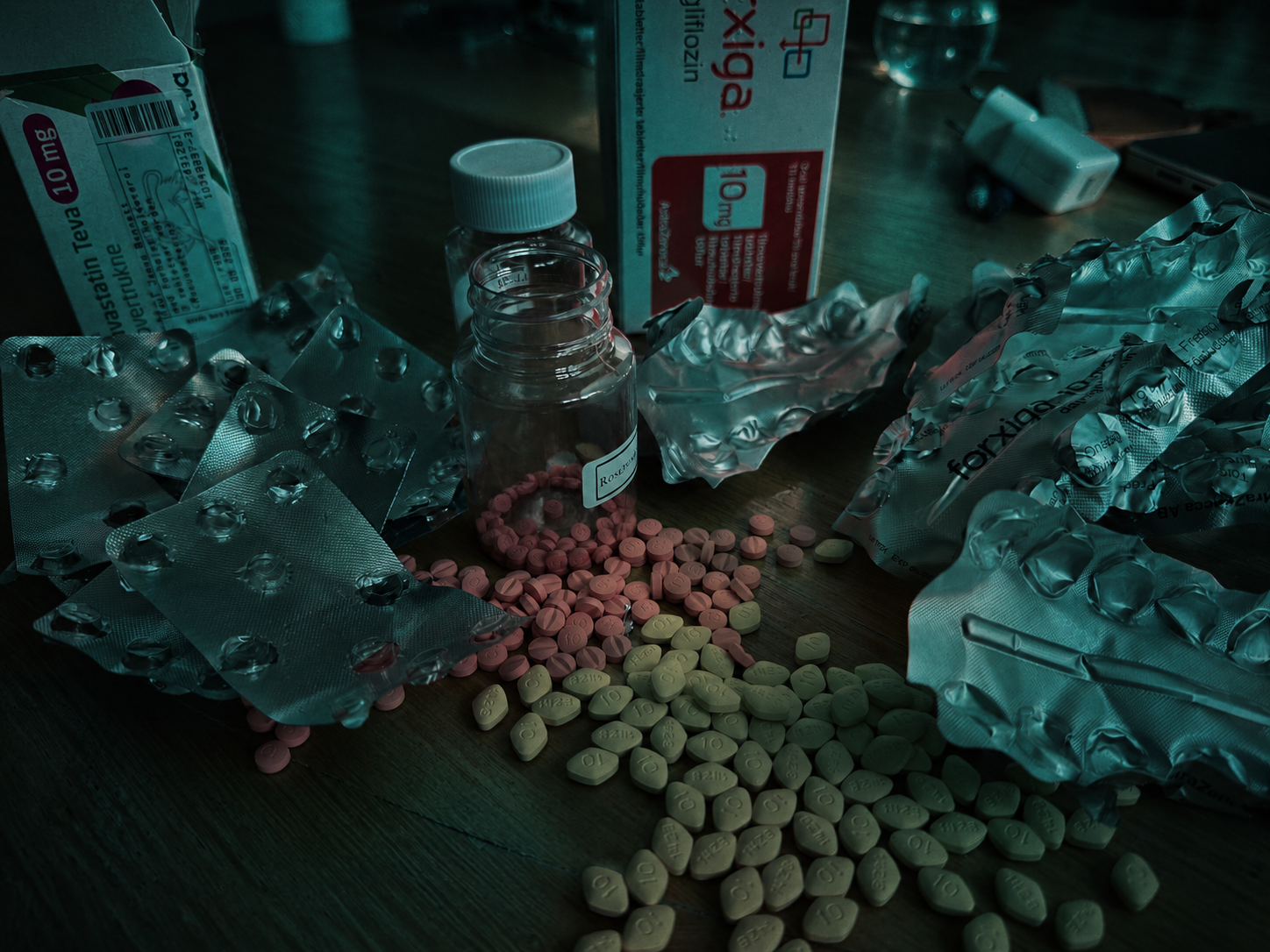
These days, I take quite a lot of medication myself. Nothing remotely approaching Michael’s hundred and twenty pills a day, but enough that they have become part of the domestic furniture of my life. Here in Europe, most of them come in blister packs, silver sheets of small white tablets lined up neatly behind foil, waiting to be pushed through. Usually on a Sunday morning I sit at the kitchen table and sort the week ahead, pressing pills out one by one and dropping them into little jars. There is something oddly meditative about it, this tiny pharmaceutical housekeeping, the pop of the foil, the tablet falling against glass, the small accumulation of things designed to keep a body going.
And there is not a single time I do it that I do not think of Michael.
I look at my own thumbs pressing against the foil and suddenly I can see his fingers again, red and blistered from doing this hundreds and hundreds of times, week after week, while still a boy. The memory has survived all these years with extraordinary clarity. Perhaps that is what I mean when I talk about empathy leaving something behind. I met Michael for a few hours more than twenty years ago, yet somehow he still sits with me at my kitchen table on Sunday mornings. His pain became lodged somewhere in my own understanding of the world, waiting for this strange little ritual of ageing to call it back.
I do not know where Michael is now. I hope, more than anything, that he is well. I hope the treatments became easier, the pills fewer, the condition something he learned to carry lightly rather than something that carried him. And I hope, perhaps sentimentally, that somewhere there is a guitar leaning against a chair. I hope those fingers learned chords. I hope they became sore from strings rather than blister packs. I hope he plays badly and loudly, or beautifully, it really does not matter. I hope he is happy.
Above all, I hope he is healthy.
And every Sunday morning, as another pill drops into the jar, I think of him.
I, Hurt