I, Grow
The creation of a thousand forests is in one acorn.
When I was a boy, I used to make fun of my father for the seriousness with which he tended his roses. Not a gentle teasing either, but the impatient, superior mockery available only to children, who have not yet discovered that adults are often kneeling at the edge of mystery doing their best to look practical. He approached those rose beds as though they were a matter of state. There was pruning at precise moments, feeding at others, deadheading, mulching, tying in, inspecting leaves for blackspot, peering at stems as though they might confess something if observed closely enough. He had secateurs in his hand with the air of a surgeon or a conductor. He moved around our tiny front garden in the chilly north of England with that absorbed, slightly furrowed expression of someone listening to a language just beyond the hearing of everybody else. To me, at the time, it all seemed kind of absurd. They were only plants, after all. Flowers. Decorative things. I could not understand why a grown man would spend so much energy worrying over a bloom, why he would stand in the evening light discussing soil and mildew and the angle of rain, why he looked almost personally wounded when an early frost browned the tender tips of a new shoot. I saw fuss. I saw obsession. I saw, in the way children often do, only surface.
It is one of the main astonishments of getting older that the things we once rolled our eyes at begin, years later, to appear before us in a completely different light, lit from within by meanings we were too young to perceive. Growth itself seems to work this way. It rarely announces itself when it is happening. It does not usually arrive with trumpets or clear declarations. More often it enters by the side door. A habit, a sentence, a gesture once dismissed returns years later charged with a new electricity. And so now, as I find myself at roughly the age my father was then, I have become a man who pores over seed packets and bulb catalogues, who notices the exact green of first shoots against dark soil in February, who can feel a foolish but sincere thrill at the sight of a peony pushing up like a red fist through the cold Danish earth. I now understand the strange intimacy of cultivation, the private, almost devotional attention it asks of you. I understand why he cared. More than that, I understand that he was not merely growing roses. Without either of us realizing it, one gardener was growing another.
Growth is too often spoken about as though it were a kind of personal conquest. We speak of self-improvement as if the self were a project plan, a thing to be optimized, scaled, upgraded, made more efficient through force of will. We speak about transformation as though it were a staircase, neat and upward, each step visible from the last. But real growth, at least the sort that matters, feels much less like construction than cultivation. It is slower than ambition likes. Less photogenic. Less obedient to narrative. It happens underground for long periods, in darkness, in silence, among roots and rot and hidden things. A seed does not become a plant by striving in the way we flatter ourselves that we strive. It becomes a plant because the conditions around it make life possible, because the shell softens, because moisture reaches it, because warmth arrives, because the dark itself does not frighten it out of being what it is. I have come to think that much of human flourishing works in precisely the same way. We do not simply will ourselves into becoming. We are made possible by climate, by care, by timing, by what we are planted beside, by what nourishes us and what shades us and what chokes us, by what is pruned away and what is allowed to spread.
This, perhaps, is one of the reasons gardening became such an important metaphor for me in my work, especially pertinent in and around government, an area I have found myself doing a pretty significant amount of work in over the last few years. I used to say, on a slide that always seemed to land in the room with a mixture of surprise and recognition, that “Design, like government, is gardening, planting seeds of hope and letting people harvest them with you.” I meant it partly as a corrective, because so much public work is still discussed in mechanical language. Systems. Levers. Delivery. Infrastructure. Targets. Engines. These words have their use, but they can seduce us into forgetting that societies are not machines. They are living ecologies, dense with feeling, memory, dependence, aspiration, fear, habit, history, fatigue, and the uneven distribution of light. You can tighten a machine. You can replace a part. You can optimize its output. But a community is not fixed in that way. Nor is a school, a neighbourhood, a health system, a welfare office, a town hall, a nation. These are gardens of a sort, whether we admit it or not. Places of interdependence. Places where small changes in condition can alter what becomes possible. Places where neglect grows its own weeds. Places where what is planted in hope may take a long time to appear above ground, and where the harvest, when it comes, belongs to more people than the hand that first put something in the soil.

A real garden teaches you early that nothing grows alone. Even the plants that look solitary are not solitary in any absolute sense. The rose depends on the soil life around its roots, on insects it does not know it needs, on the neighbour plants that keep moisture in the ground, on the hand that waters in a dry week, on the absence of one blight and the presence of another more generous organism. Some plants protect each other. Some exhaust the same nutrients and leave each other starved. Some climb only because another gives them structure. Some flourish in a crowd. Some require room. There are combinations that produce abundance and others that quietly diminish everything around them. This is true in a kitchen garden and true in human life. We like to talk about people as though character were an isolated possession, as though resilience, confidence, creativity, even kindness, sprang fully formed from within the individual. But we are companion-planted creatures. We grow in relation. We are shaped by adjacency. The right conversation can be as important as rain. The wrong culture can poison like bad drainage. A generous colleague, an encouraging teacher, a friend who believes in your half-formed idea before you have words for it yourself, these are forms of sunlight. So too is love, though love has weather in it. So too is belonging. So too is the felt sense that one’s growth is not a trespass.
I think often about emotional weather, about the moods and pressures and inner climates that pass through us with all the instability of spring. Anyone who gardens knows that weather is not background. It is not scenery. It is a participant. A week of warm days can coax everything forward too soon. A hard rain can flatten what looked robust only the afternoon before. A single night of unexpected cold can interrupt an entire season’s confidence. Human beings live under these systems as surely as plants do. There are days when the mind feels like a glasshouse; bright, expansive, full of possibility, everything tender but reaching. There are others when grief moves in like a low pressure front, pressing close to the ground, making every gesture heavier than it should be. Anxiety can feel like wind, drying the edges of thought, making even sturdy things tremble. Shame can behave like blight, spreading in the hidden places first. Joy, when it arrives, has the sudden flooding quality of sun after rain, the whole inner garden steaming slightly, leaves sharpened, colours saturated, life remembering itself. To grow well is not to escape these conditions. It is to become more discerning within them. To know when something needs shelter and when it needs air. To know that not all seasons are for flowering. To know that dormancy is not failure, that there are periods in a life when all visible growth withdraws and yet vital work continues in the dark.
There is also the difficult, unromantic matter of weeding. Any sentimental view of growth tends to forget this, because we prefer the language of blossoming to the language of removal. Yet a garden left entirely to its own devices does not become paradise. It becomes struggle. Certain things take over. Certain vigorous growths present themselves as abundance while quietly stealing light, water, and room from what is slower, more tender, more valuable. Human lives are no different. Nor are institutions. Some habits look productive but are merely invasive. Busyness is one of them. So is performative urgency. So is that brittle species of competence that values control over aliveness. In public systems especially, I saw how procedures can multiply like bindweed, how meetings self-seed, how defensive language spreads across an organization until the original purpose is almost hidden beneath the foliage. Then design, at its best, is not adornment. It is pruning. It is thinning. It is making space. It is the brave and often unpopular decision to say, this is not helping anything grow. Let it go. It is astonishing how much hope can return to a person, a team, or a system simply because something unnecessary has been cut away and suddenly, after months or years of shade, light gets in again.
And yet gardening is not only about restraint. It is also, gloriously, about faith. Every act of planting is an argument against despair. You press something dry and unimpressive into the earth, something that looks more like a mistake than a future, and then you wait. You water. You watch. You trust processes you cannot command. There is something profoundly moving in this, especially now, when so much of modern life trains us toward immediacy. We want evidence at once. We want traction. We want metrics. We want visible returns. But seeds are not startups and souls are not quarterly reports. Some of the most important work we do with each other has almost no immediate proof attached to it. A conversation with a teenager. A small redesign of a service so that the first form someone sees is less bewildering, less cold, less punitive. A classroom arranged differently so that students can see each other. A public waiting room made more dignified. A policy reframed in language that sounds like a human being wrote it for another human being. These are seeds, often tiny ones, but they alter conditions, and altered conditions change lives in ways that are hard to track and impossible to fully predict. Hope, in this sense, is not a mood. It is horticultural. It is work done on behalf of futures you may not personally get to enjoy.
This is why the metaphor of mutuality feels so essential to me. In a flourishing garden, the point is not that each plant triumphs individually. The point is that life is made more possible by the pattern of relation. The tall thing gives shade. The low thing holds moisture in the soil. The flowering thing draws pollinators for the fruiting thing. The nitrogen fixer enriches the ground for the hungry neighbour beside it. There is elegance in this, but also instruction. Human beings, despite our myths of rugged individuality, are built for this kind of reciprocity. We become more fully ourselves not in splendid isolation but in good company, in systems that understand support as architecture rather than afterthought. The healthiest teams I have seen, the healthiest cultures, even the healthiest friendships, all have something of a well-planned border about them. Difference in height, temperament, tempo, flowering time. Enough variety for resilience. Enough structure for support. Enough generosity in the soil so that not every interaction must be a competition for scarce nutrients. This is true socially, emotionally, politically, creatively. Diversity is not just a moral aspiration. It is an ecological intelligence. Monoculture is always more fragile than it first appears.
Perhaps this is where design comes back in, not as styling, not as surface, but as the practice of arranging conditions for life. The best designers I have known are not really in the business of making objects at all, though they may produce them. They are in the business of cultivating better relationships between things. Between person and place. Person and service. Person and institution. Person and person. They notice friction the way a gardener notices wilt. They understand that the health of a system is often revealed at its edges, in the places where something tender is trying to emerge and cannot. They are suspicious of brilliance that exhausts the soil. They know that growth forced too quickly can be weak and that anything living needs maintenance after the unveiling. There is humility in this way of working, because it shifts the emphasis from authorship to stewardship. The ego wants to be the heroic maker, the genius with the plan. Gardening asks something more grown-up. It asks that you collaborate with life, that you make room for other agencies, that you accept weather, contingency, seasonality, and the fact that some of the most meaningful outcomes will be harvested by people who never know your name.
And harvest does matter. Not the flashy kind, not applause or headlines or the polished case study, but the deep, ordinary proof that something nurtured has become usable, nourishing, shared. A service that once humiliated people now receives them with dignity. A school once organized around compliance begins to produce curiosity. A neglected patch of civic life, given attention and trust and patience, becomes a place where people recognise themselves again. This is the harvest design should care about. Not mere novelty, but sustenance. Not admiration, but participation. Not the flower cut and displayed for a moment, but the perennial that returns, stronger and more itself each year because the roots were given what they needed.
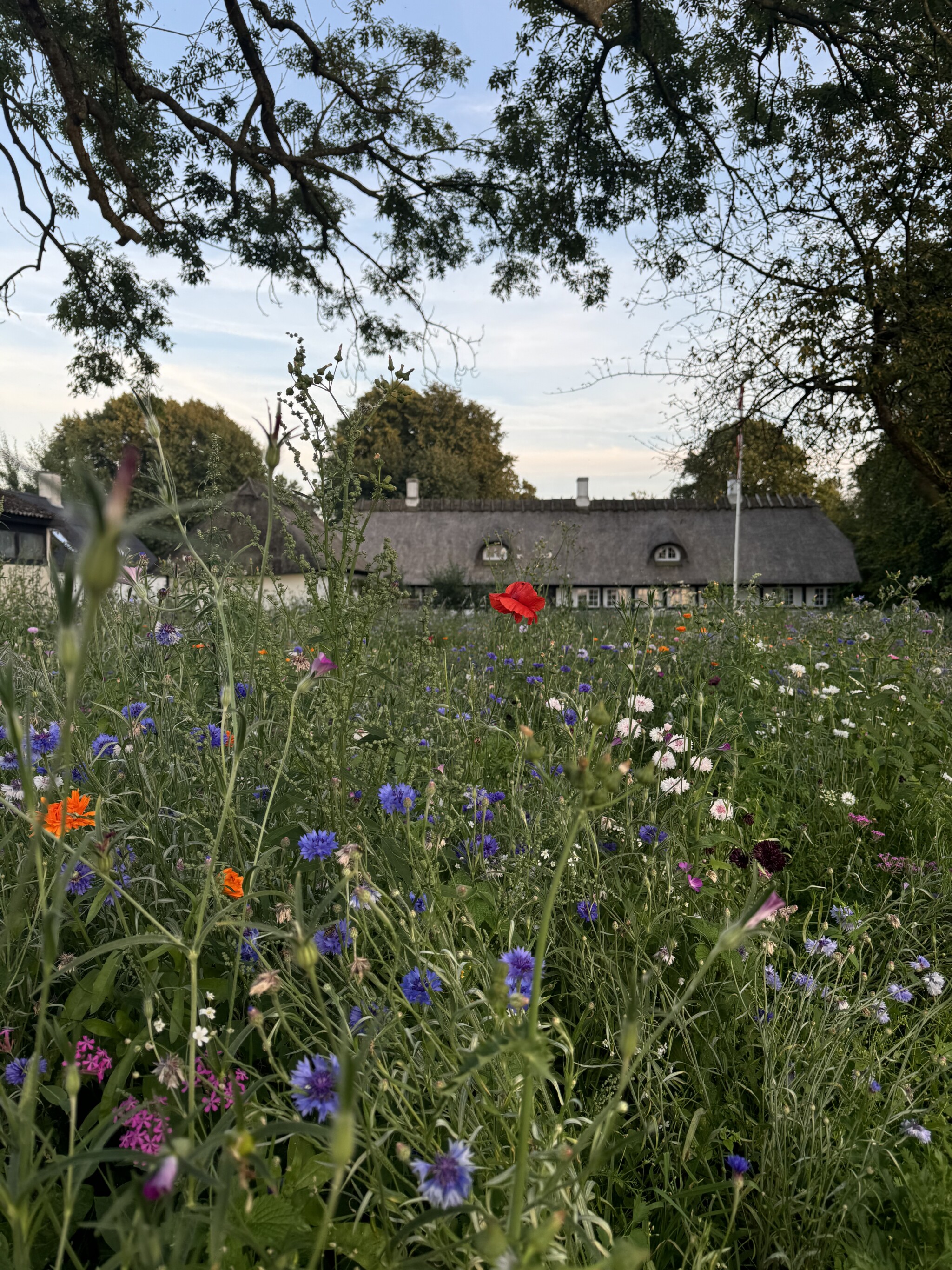
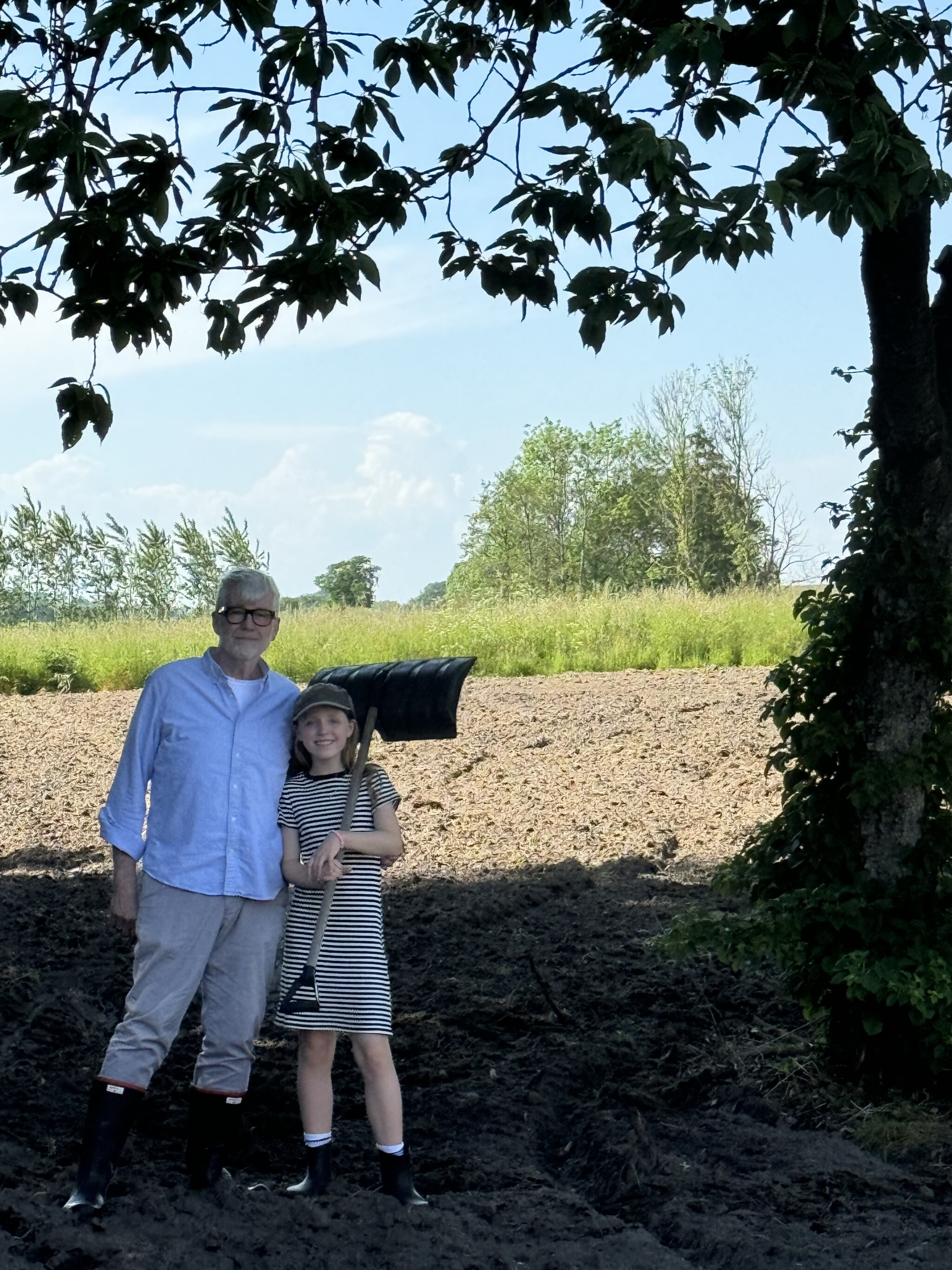
And so I return, at the end of all this, to my father among his roses, bending over a plant I thought was merely ornamental, doing work I thought was merely fussy, participating in a cycle I was too young to understand. I can see him now more clearly than I could then, the concentration in his face, the patience, the attentiveness, the willingness to care for something that would never obey him completely and yet rewarded him, season after season, with beauty that had to be earned in cooperation with weather, disease, timing, luck, and love. I used to laugh at that devotion. Now I find myself in its lineage. Here I am, the same age he was, turning packets of seeds over in my hand in the garden center, considering depth and spacing and first frost dates, wondering whether Jim’s newly planted meadow will get enough sun, whether the soil wants more compost, whether this year is the year for sweet peas. Here I am listening to rain at night not only as atmosphere but as news. Here I am understanding at last that gardening is never only about plants. It is about attention. It is about relationship. It is about believing that what is small and buried and apparently inert may contain an entire future if met with the right kind of care. And perhaps that is true of people, too. Perhaps it is true of communities, of governments, of institutions, of ideas. Perhaps the work, whether in a garden or in design or in a life, is simply this. To notice what might grow. To prepare the ground. To protect the tender things. To thin what chokes. To trust mutuality. To stay through the weather. And then, when something finally flowers, to recognise that the harvest was never yours alone. It belonged to the whole living arrangement. One gardener, growing another, and both of them, in the end, being grown by the garden itself.
I, Grow.
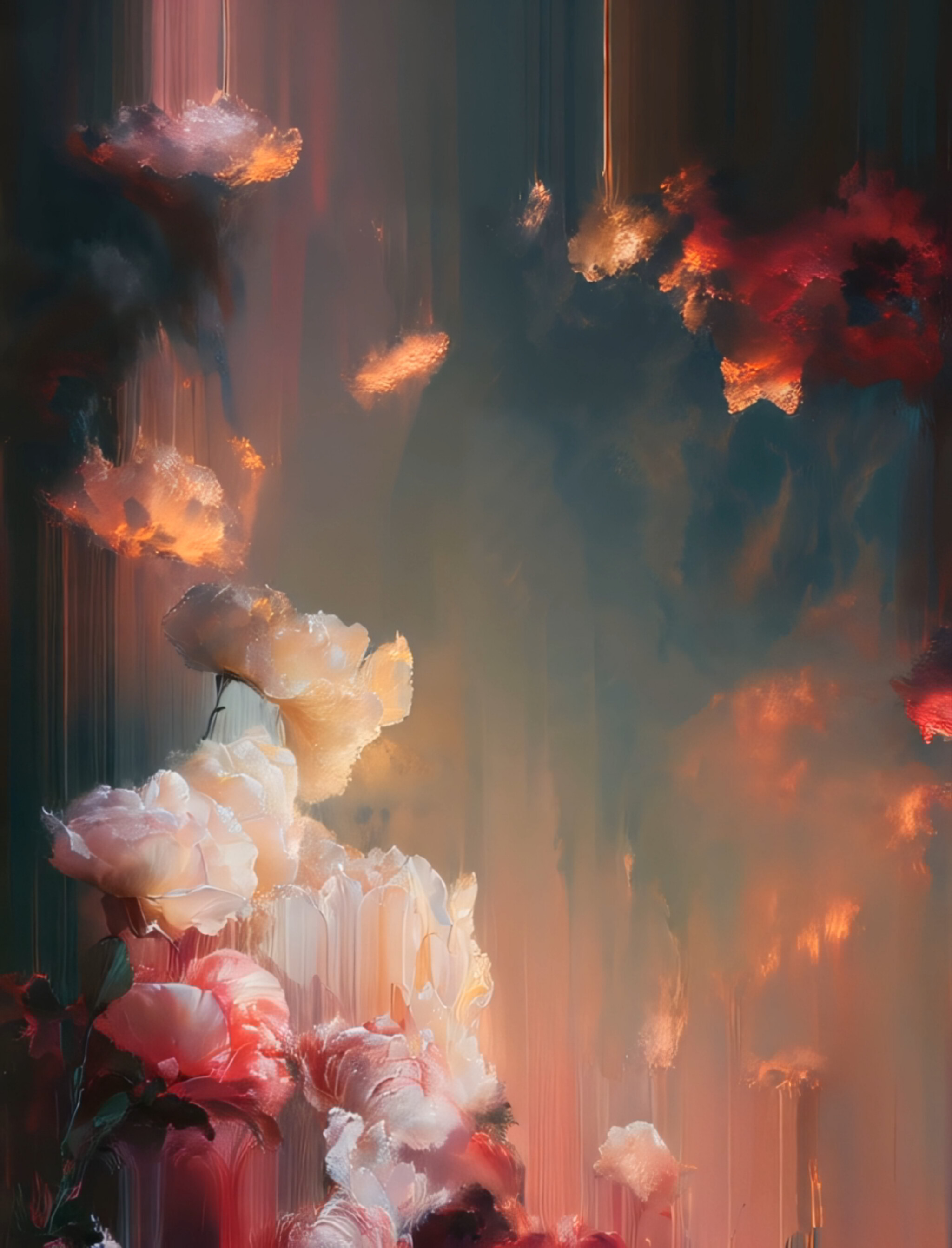
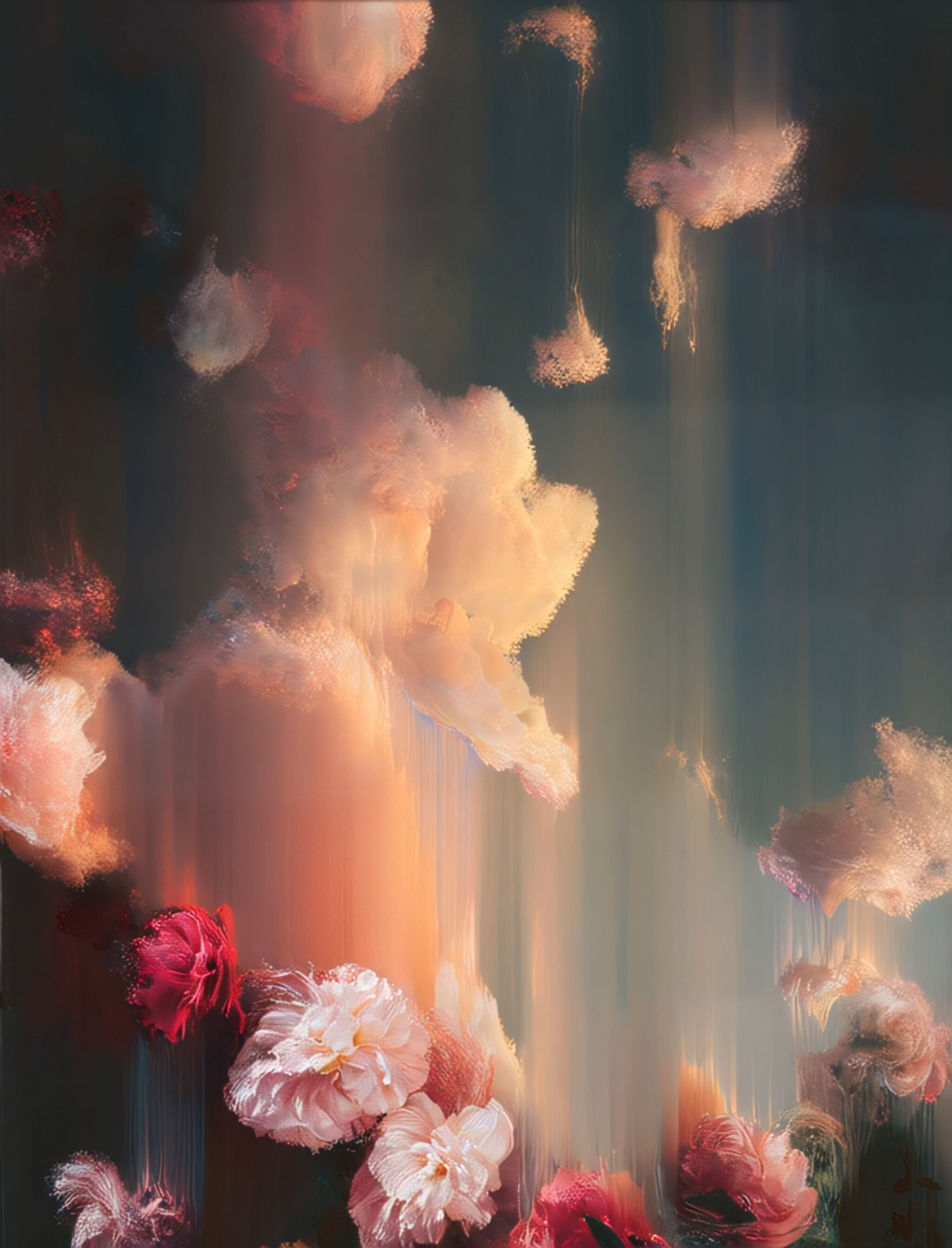
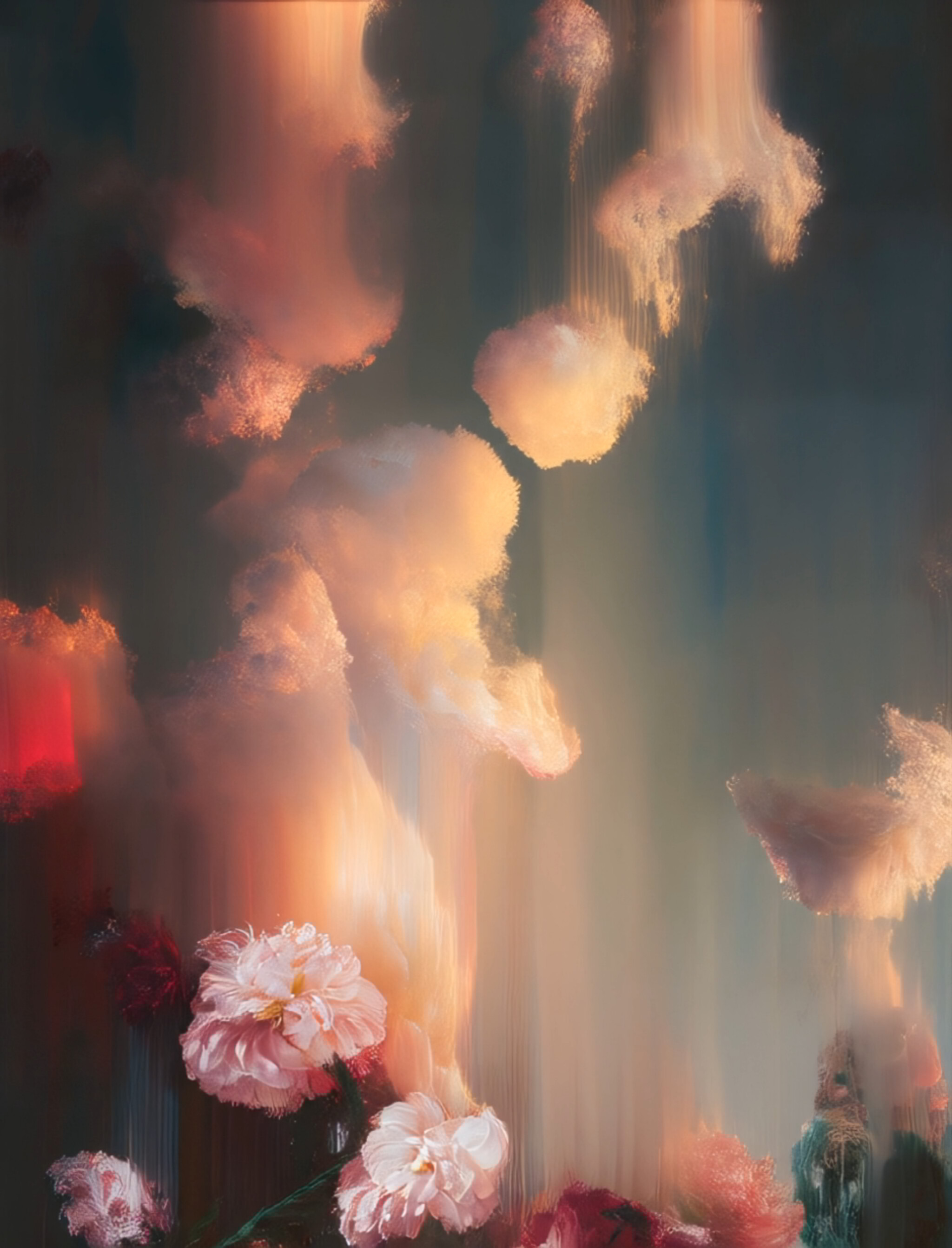
A note from Lindsay Kokosa, my collaborator on the beautiful imagery for this piece. I saw her work on Instagram and was hooked. Kindly she allowed me to use them of this piece, for which I am eternally grateful. She writes
Rising Light, 2026
My work often explores transformation, inner states, and the quiet shifts that shape who we become. I’m drawn to moments that are difficult to name, the spaces between endings and beginnings, uncertainty and clarity, holding on and letting go. Through flowing forms, dissolving edges, and luminous movement, I try to create images that feel alive with change.
Flowers have always felt symbolic to me, not only for beauty, but for their cycles of opening, fading, and returning. They carry both fragility and resilience. In this piece, the forms seem to melt, bloom, and reassemble, echoing the way growth often happens, rarely in a straight line, and often through softness, disruption, and surrender.
There is also a sense of the flowers rising into the clouds, a reminder that while we are rooted to the earth, we still carry the ability to dream, to lift our perspective, and to keep opening beyond old limits. Growth is both grounded and aspirational. It asks us to stay connected to what is real while remaining open to what is possible.
Much of growth happens quietly, beneath the surface, where something old loosens and something new begins to emerge. That gentle becoming is at the heart of what inspires me.
About Me:
Lindsay Kokoska is a Canadian multimedia artist and founder of Infinite Mantra Art Studio. She works across traditional and digital mediums, blending painting, fine art compositing, animation, and generative AI to create abstract, surreal, and figurative environments inspired by the cosmos, inner awareness, and the unseen layers of human experience. Her pieces explore other dimensions, consciousness, meditation, and abstract forms through dreamlike imagery and contemporary digital processes.
Her visual language moves between abstraction, surreal elements, and subtle figurative forms, often carrying a quiet transcendental quality. Through movement, color, and layered composition, her work invites viewers to pause, shift perspective, and connect with a deeper part of themselves. She aims to create spaces that evoke reflection and allow people to recognize the magic that already exists in their own lives.
With a background in education and marketing, Lindsay holds a Master’s degree in Graphic Art and has studied at the Toronto School of Art, along with independent studies in Bali. Her practice has grown through a mix of formal study and years of self directed experimentation across both traditional and digital mediums. She believes in the open possibilities of creativity and encourages viewers to explore the connections between their material and inner experiences.