I, Heart
“Tears come from the heart and not the brain.” - Leonardo da Vinci
I found myself standing in a stem cell laboratory in far-upper Manhattan, invited to help raise support for research that might one day regenerate diseased and damaged organs and tissue. The room was bright, immaculate, and disciplined in its precision. Stainless steel surfaces reflected white light. Incubators hummed softly. Scientists moved with the quiet confidence of people fluent in processes too small for the naked eye. Their language rose and fell in technical cadence. Pluripotent stem cells. Differentiation pathways. Signaling cascades. I wanted to be enthralled by every word, yet I felt my attention thinning as terminology accumulated faster than meaning.
The woman leading our tour paused when she noticed my wandering focus. She studied my face with gentle curiosity and then turned to a colleague. “Take him to the nursery,” she said. The word struck me with surprising force; my imagination lurched somewhere dark and medieval. She saw the shift in my expression and laughed softly. “No, no. It is where we hatch new stem cells.” Hatch. The atmosphere changed instantly. The language of procedure gave way to the language of emergence.
She adjusted a microscope and directed my gaze toward a screen. At first I saw scattered specks suspended in a pale field, motionless and indistinct. Then one pulsed. Another followed. Gradually, almost shyly, individual cells began contracting in proximity to one another. What had appeared random started to align. The science would describe ion channels opening and closing, calcium flowing across membranes, electrical impulses traveling through microscopic junctions until isolated contractions synchronized into collective rhythm. Yet what I witnessed felt far simpler and far more profound. I watched life resist isolation. I watched coherence form out of fragmentation. As we stood there observing those newly forming heart cells begin to beat together, she spoke quietly beside me. “Love is biological. Even on a cellular level we do not want to be alone.”
The sentence entered me deeply because not long before this day, I had woken up alone on a marble floor in London.
There had been no drama in the fall, no cinematic distortion of time, no signal that something irreversible was underway. I woke face down in a hotel bathroom, my cheek pressed against cold marble that felt almost indifferent in its stillness. For several seconds I did not understand where I was. The world was reduced to temperature and weight. My body felt unfamiliar, as though it had become an object placed there without instruction. When sensation returned it did so unevenly. My arm would not respond. It was trapped beneath me at an angle that made no anatomical sense. In the instant before I collapsed, I had thrown it forward to shield my head from the sharp edge of a marble tub. Instinct had acted faster than thought. The arm had accepted the cost.
There is a quiet humiliation in discovering that you are not sovereign over your own machinery. I remember thinking, absurdly, about meetings scheduled later that day. Emails unanswered. Commitments pending. The mind clings to normalcy long after the body has exited the agreement. Beneath that reflex was something far more unsettling. A dawning recognition that the muscle in my chest, the one I had never once negotiated with, could falter without warning. Not out of anger. Not out of betrayal. Simply because it could. I was furious with it. With myself.
The ambulance arrived with efficient calm. Hands lifted me. Voices spoke in tones designed to steady panic. I felt both grateful and strangely erased. In the hospital corridor the lights were too bright, the air too dry, the ceiling panels passing overhead in mechanical succession. I became aware that I was being translated into data. They put me in Room 3. Electrodes adhered to my skin. A young medic came in, he had kind eyes. He told me his name was Ed and asked: “Is it OK if I call you Paul?” A cuff tightened around my arm. A monitor began converting my pulse into numbers and light. My heart, which had carried me through decades of ambition, travel, argument, love, and effort without ever requesting acknowledgment, was now a fluctuating signal. I felt like I was falling backwards.
Bells started ringing. “Crash Cart to Room 3.” Fuck. I’m in Room 3.
Suddenly, all systems collapsed, a single white dot like the old television signal that I used to remember as a kid. Lying there, I experienced a peculiar duality. I was surrounded by competence and care, yet profoundly alone inside my own body. Professionals moved with admirable precision, their language clipped and exact. I respected them deeply even as I felt myself shrinking under fluorescent light. Each person introduced themselves to me and asked if it was “OK for them to call me Paul.” Maria. AbdulRaman. Katy. Fergus. Ronny. When they spoke about my condition in clinical terms, I understood the necessity of clarity, yet something subtle withdrew within me. It is disorienting to hear your body discussed as malfunction while you are still fully inhabiting it. I wanted to say, I am here. I am more than this event. I am that person you are calling Paul, not the patient trapped inside his body. I was standing upright this morning believing in my own momentum.
Fear did not arrive as panic but as exposure. I felt dependence settle into the mattress beneath me. Much of my identity had been constructed around capability and contribution. I was accustomed to being the one who designs, who advises, who leads. Now I could not stand without assistance. I could not will my heart into steadiness. I could not interpret the machines without someone else’s expertise. There was a tenderness in that helplessness that stripped away performance. What remained was something raw and honest.
I made it.
During my recovery over the next 48 hours, bored and fidgety, I learned about Kate Granger, a physician in her early thirties who had been diagnosed with terminal cancer. She had spent her life caring for others, fluent in medical systems, respected in her field. Then she became the patient. As she lay in hospital beds of her own, she noticed something small yet piercing. Clinicians entered her room and began examinations without introducing themselves. Not from cruelty, but from momentum. Efficiency had replaced presence. In those moments she felt invisible. Not because she doubted their skill, but because no one had paused to acknowledge her humanity.
So she began asking for something disarmingly simple. She encouraged healthcare professionals to begin every interaction with three words. Hello, my name is. Those words became more than etiquette. They became a reclamation of dignity. A reminder that before we are cases or diagnoses, we are people. Her initiative spread across hospitals and across countries because it answered a quiet ache. Recognition precedes care. To be healed, one must first be seen.
When I heard her story, I felt a deep resonance. I could recall the nurses and doctors who had taken an extra second to meet my eyes before adjusting a line, who had asked not only about pain but about fear. Those gestures were technically unnecessary, yet they restored something essential. They bridged the gap between system and soul. They reminded me that care is not only intervention but acknowledgment. Machines did not save my life, words did.
When my own cardiologist stood at my bedside, he did not dramatize the situation. An older Glaswegian gentleman in a dapper tweed suit, he looked at me steadily and said, “You are only given one heart. Treat it with the respect it deserves.” There was no accusation in his voice, only piercing clarity. The sentence landed with unusual weight because it acknowledged fragility without surrendering hope. Watching the green line rise and fall on the monitor beside me, I felt embarrassment braided with awe. I had treated my heart as infrastructure rather than miracle. Each steady beat felt like grace. Each irregularity felt like instruction.
Standing later in that laboratory nursery, watching scattered cells synchronize into rhythm, I began to see the pattern. Coherence forms when connection is acknowledged. Life seeks alignment. Isolation is tolerated briefly, but not sustained.
We live in a culture intoxicated by cognition. We measure, optimize, forecast, and quantify with extraordinary sophistication. We build dashboards and predictive models sharpened to intellectual clarity. Intelligence is prized and certainty admired. Entire organizational cultures are structured around the belief that thought alone will solve complexity. Yet intelligence by itself does not generate coherence. I have sat in boardrooms where the data was impeccable and the atmosphere fragmented. Capable leaders operated at the height of professional competence, yet emotionally guarded. Language became technical. Positions hardened. Emotional neutrality masqueraded as strength. It felt like watching individual cells contract independently, impressive yet unaligned.
But occasionally, someone sets the slides aside and speaks without armor. They admit uncertainty. They name fear. They acknowledge the human consequences of a decision. In those moments something shifts physically in the room. Shoulders lower. Breathing deepens. Listening replaces positioning. What had been a collection of optimized individuals begins to synchronize. I have described it thus many times since: “The story of the heart, told from the heart, opens the heart.” This is not sentimentality. It is synchronization. Just as cardiomyocytes align through microscopic currents, human beings align through shared vulnerability. Emotion is infrastructure. Poetry compresses meaning. Humanity anchors strategy to consequence.
The challenges before us are systemic and morally complex. Climate, technology, health, inequality, artificial intelligence. These will not yield to spreadsheets alone. They require leaders who can hold data and dignity within the same field of awareness. They require institutions that understand that optimization without empathy becomes extraction. In my own design practice, and in my work with younger designers, I feel this responsibility intensify. It is not enough to cultivate brilliant minds. We must nurture open hearts. Good design activates emotion first, which in turn activates thought, which then guides the hands. Coherence precedes construction.
In a laboratory nursery I watched scattered impulses gather themselves into rhythm. On a marble floor I felt my own rhythm falter without warning. In hospital rooms I learned how much it matters to be named before being treated, to be seen before being managed. In boardrooms I have watched alignment emerge not from sharper argument but from shared vulnerability. Across all of it runs the same quiet current. Coherence is not forced. It is invited.
There is only one heart beating inside each of us, steady until it is not, faithful until it falters. Most of the time we move through our days without noticing it, building plans upon its reliability, assuming tomorrow will resemble today. Yet every beat is both ordinary and improbable. Every rhythm is a small act of continuation.
I no longer hear the instruction as a warning. I hear it as a tenderness. You are only given one heart. Treat it with the respect it deserves. Not because it might fail, but because it is already carrying more than you know.
And somewhere beneath language and ambition, beneath systems and strategy, something in us continues to seek alignment. Even at the cellular level, we do not want to be alone.
I, Heart
A heartfelt note about Yeonjeong Jang, 장연정 my amazing collaborator on this piece.
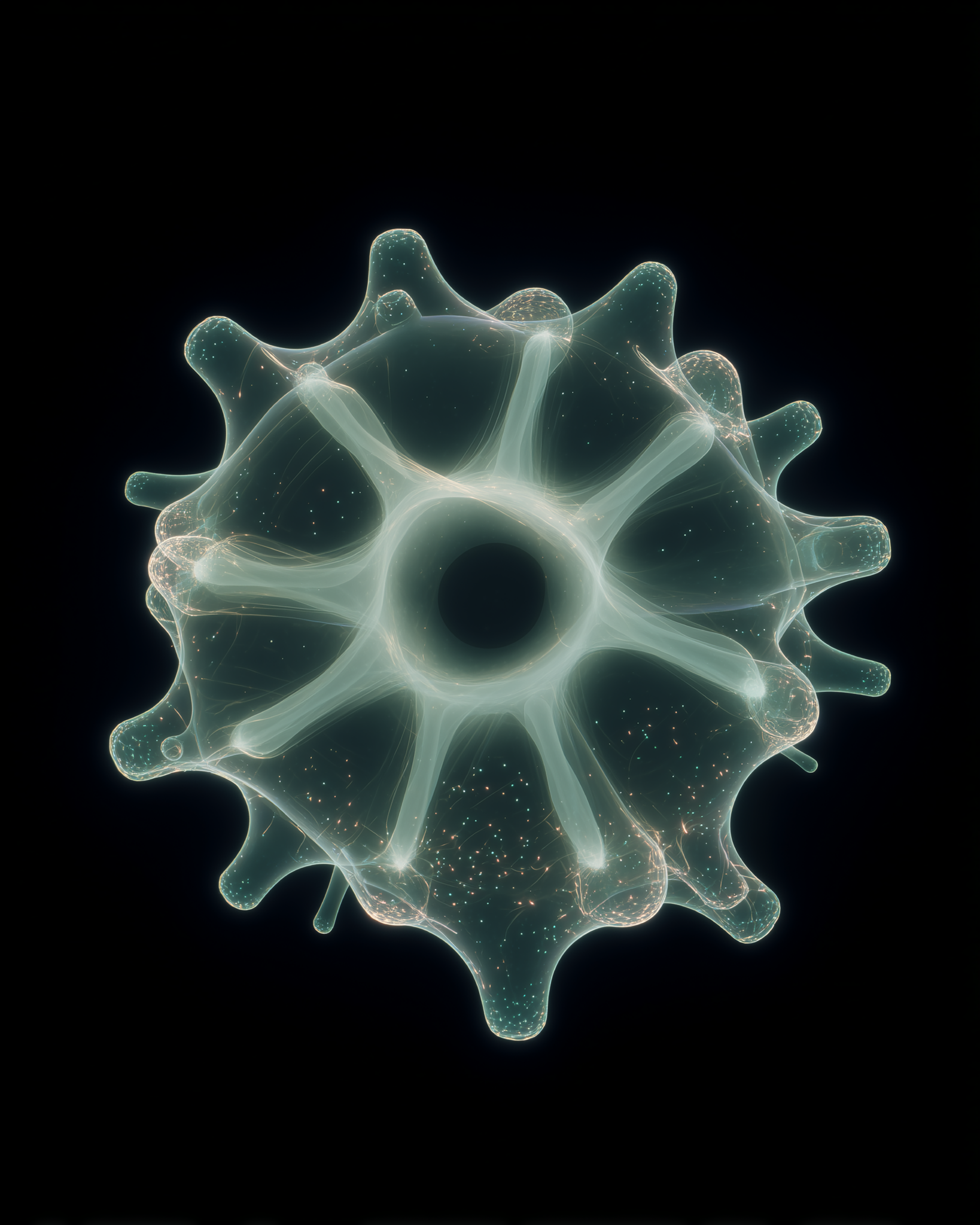
I saw Yeonjeong’s work on Instagram and, against all my inherent fears, wrote to her directly and asked her if she would consider collaborating on this piece. She has carefully crafted a beautiful, poetic response, in her words “allowing the forms to unfold and breathe naturally.” It expresses the beauty and fragility of the heart, told, from the heart.
Her artist statement says it all.
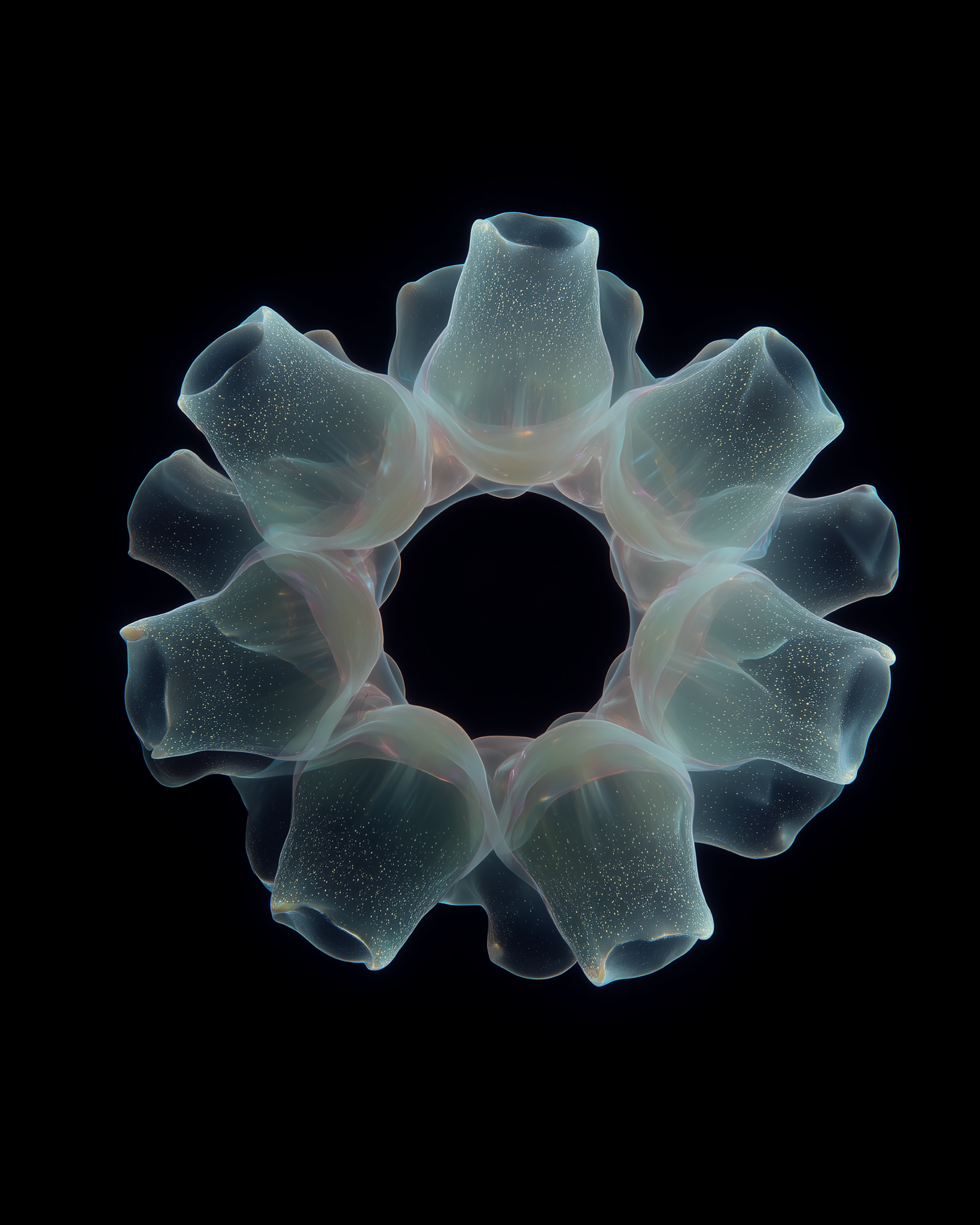
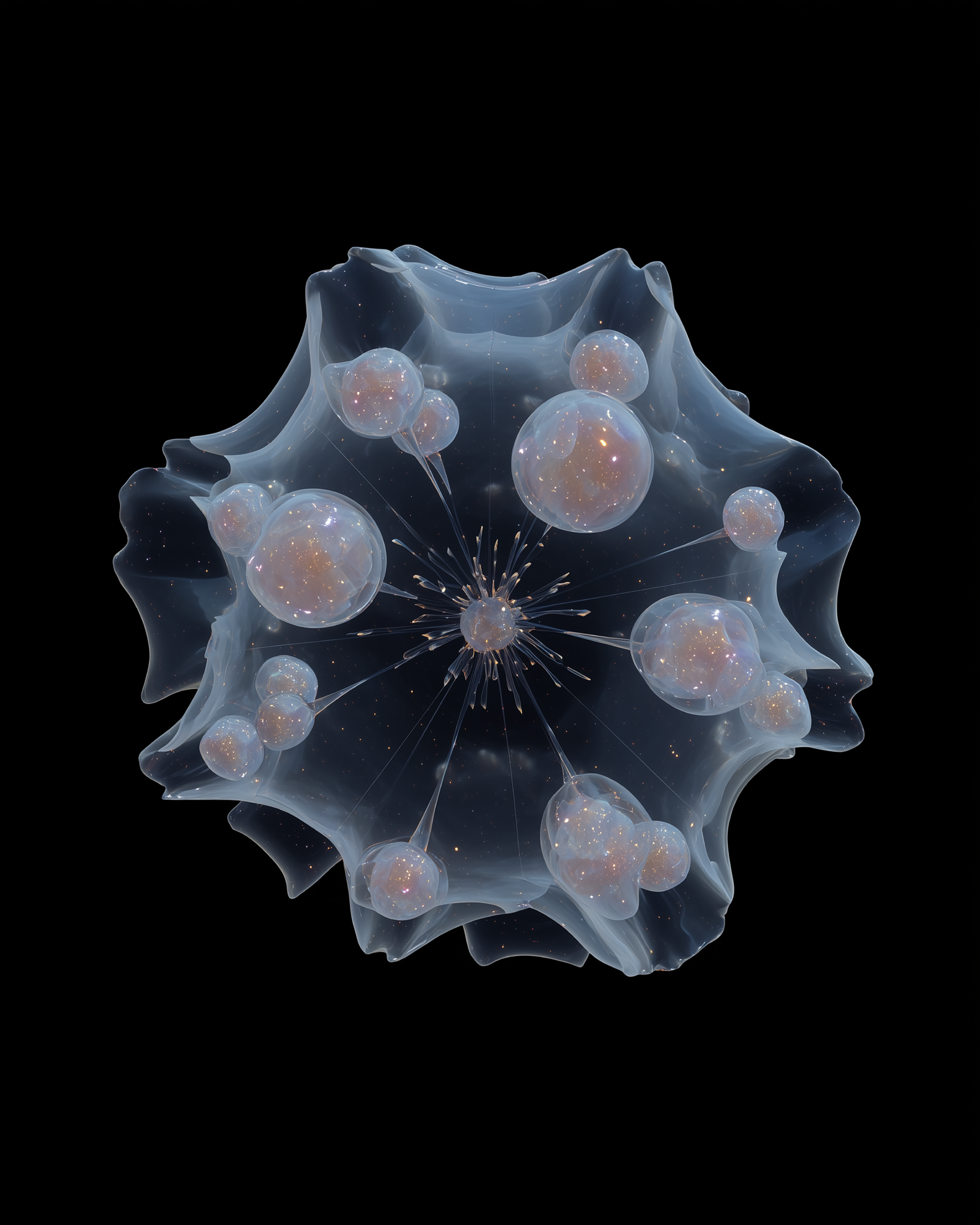
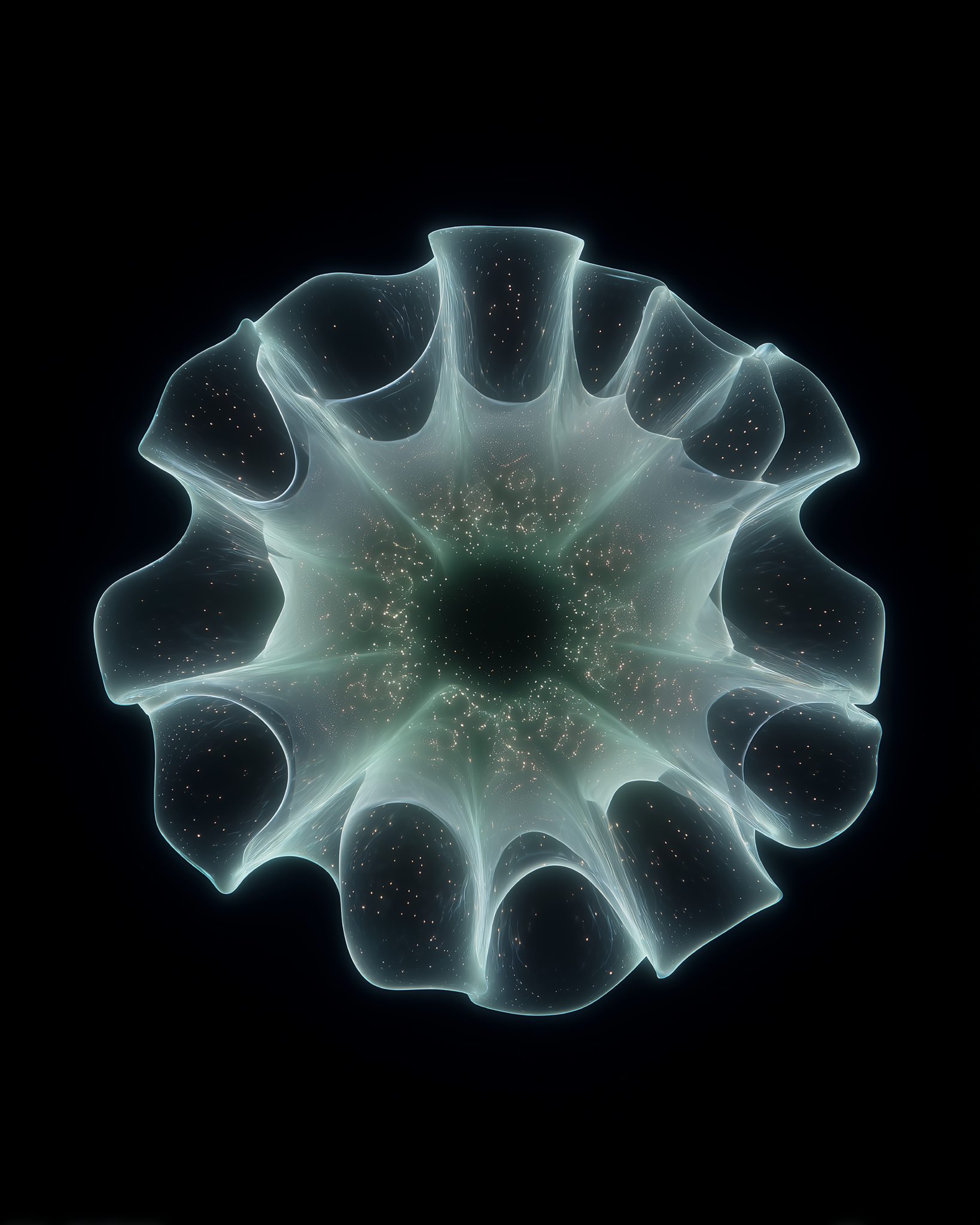
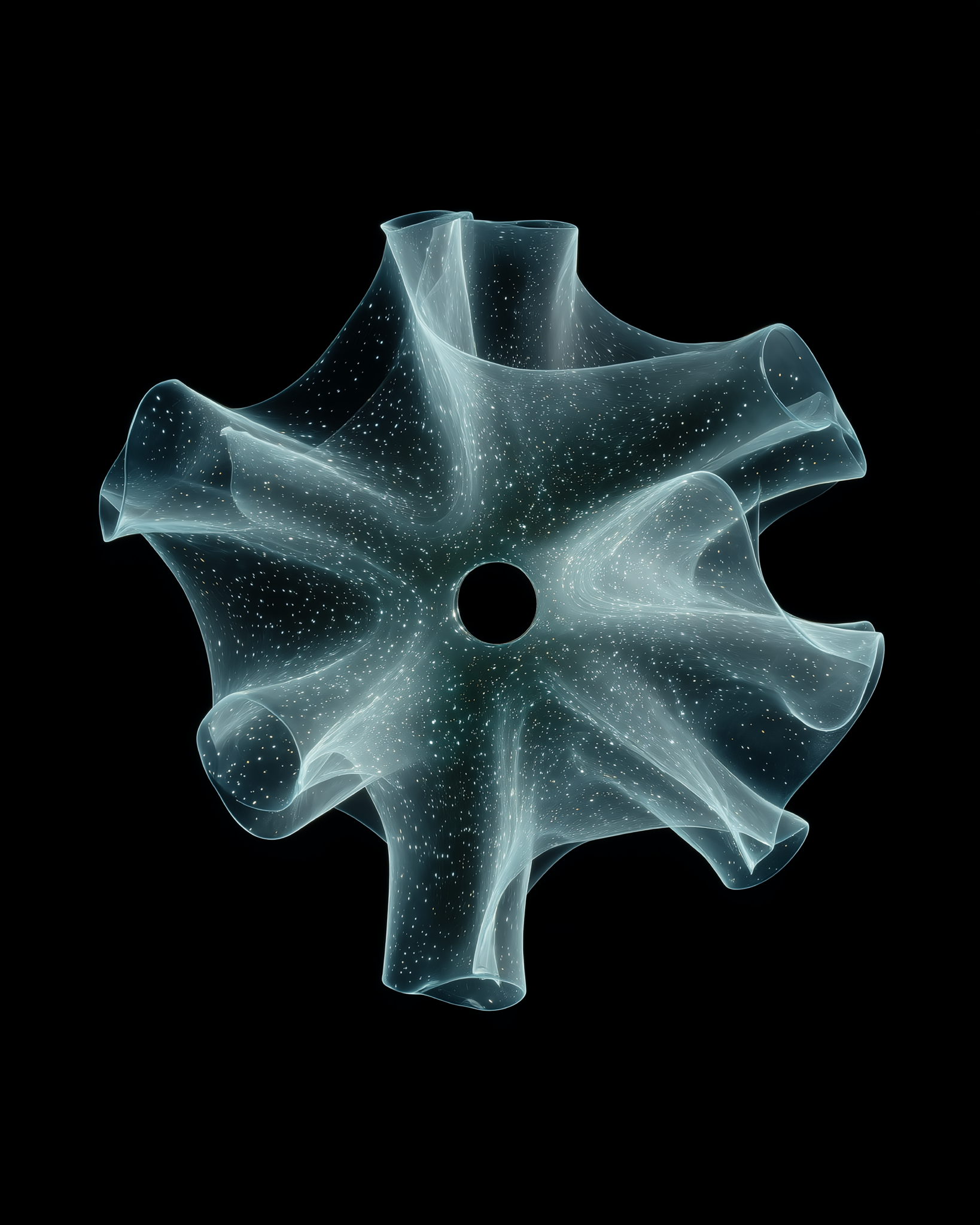
This work was developed in response to the conceptual framework of the I-Heart project, which explores the biological and poetic dimensions of the heart as both anorgan and a symbol of life.Rather than depicting the heart itself, this series focuses on an earlier moment: the stage in which biological matter begins to organize into structure. The forms presented here resemble cellular constellations or microscopic organisms, yet they remain intentionally ambiguous. They occupy a speculative space between dispersed biological elements and an emerging anatomical body. Across the sequence, clusters gather around a central field. Radial structures slowly appear, suggesting the possibility of a shared center and an eventual rhythm. These formations hint at the early logic of the heart an organ defined not — by shape alone, but by synchronization.
Through translucent surfaces, suspended particles, and subtle structural alignment, the work reflects on the fragile moment in which biological matter begins to coordinate itself. It imagines a pre-cardiac stage of organization, where structure is still searching for rhythm.
You can view her work at https://www.instagram.com/forside_art/